Child-Centered Educational Experience
Raven's Wild World
A child-centered field guide for exploring 100 birds and dinosaurs through search, filters, profiles, quizzes, comparisons, favorites, and random discovery.
Technologies TypeScript · React · Vite
A direct request from the target user
Raven's Wild World began when a child asked her father to build her a website. The goal was not to turn a simple idea into a long requirements exercise. It was to make something she could explore independently, then learn from how she actually used it.
The project followed a compressed product cycle: Discovery Lock, Working Alpha, Raven Review, and Acceptance. That first release established the interaction model. V2 keeps the same project identity and expands the field guide from twelve creatures to 100.
Built for independent discovery
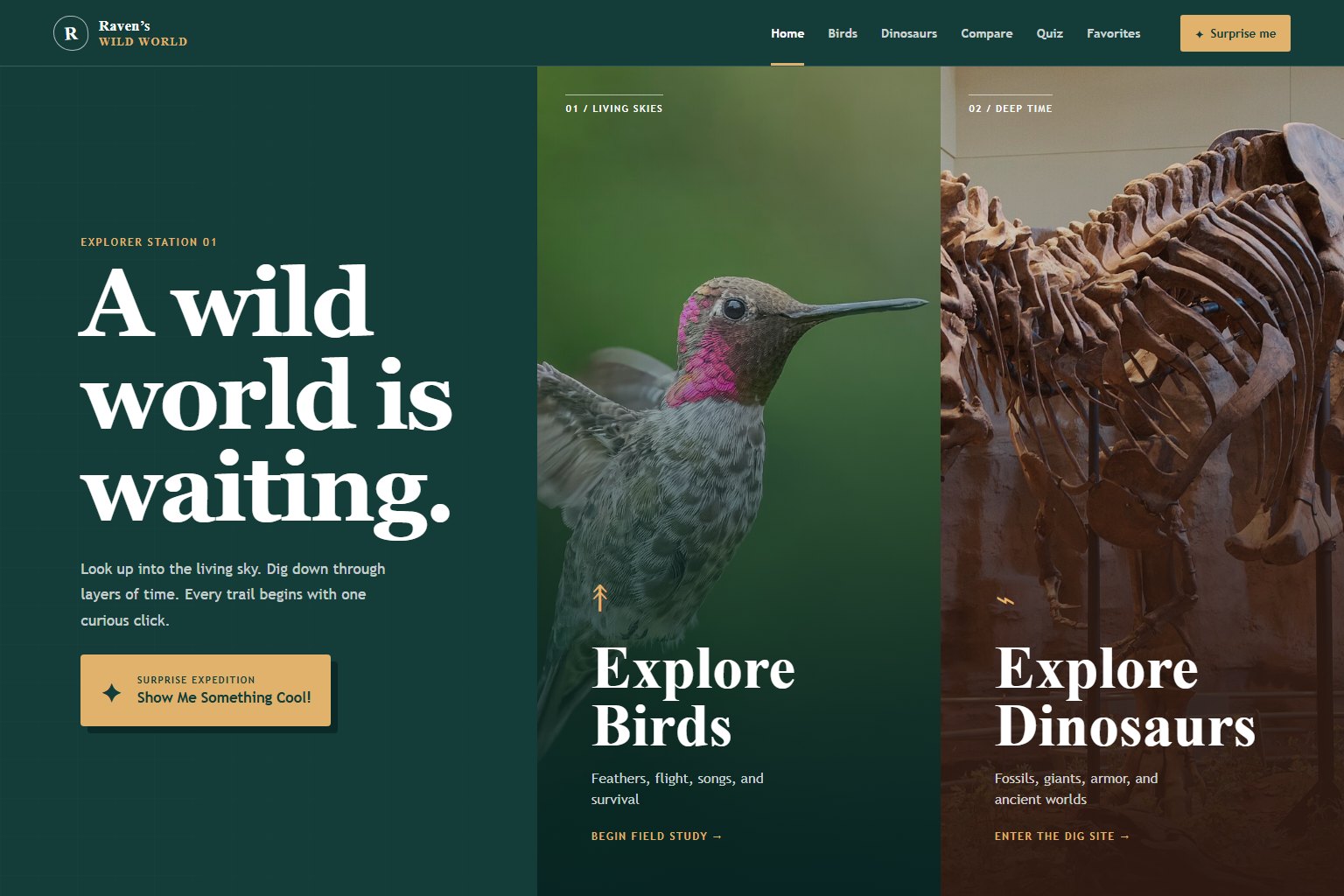
The accepted V2 experience contains 50 birds and 50 non-avian dinosaurs. Search and bird-group, dinosaur-period, and diet filters make the larger collection practical to browse. Children can follow related discoveries, compare creatures, work through a 20-question quiz, save favorites, or ask the site to show them something unexpected.
The interface uses responsive collection layouts, strong interaction states, descriptive image text, keyboard-accessible controls, and reduced-motion support. Educational references and image credits remain connected to each creature profile, while dinosaur records state the evidence behind reconstructions and inferences.
Structured content and browser-side state
Reusable TypeScript creature records drive browsing, search, filters, profiles, comparison, quiz choices, random discovery, related creatures, and Favorites. Automated dataset checks enforce the exact 50/50 roster, required fields, valid relationships, quiz references, and image metadata. React manages the interactive views. Favorites persist in localStorage, while the random explorer avoids repeating the immediately previous discovery with session state.
The 100 local JPEGs are optimized for the collection and paired with machine-readable creator, license, license URL, and source-page metadata. Asset validation checks file presence, dimensions, manifest parity, and supported licenses before release.
The application is a static Vite build. It has no accounts, database, or production backend. That boundary keeps the showcase accurate and lets the same accepted experience run under the Broken Pickaxe project path.
Review with the actual user
Raven chose Birds first, then explored Dinosaurs. She independently found the Quiz, compared multiple dinosaurs, and noticed Favorites. Her response was strongly positive. The only minor observation was that the small favorite star's connection to the Favorites page needed explanation.
That observation remains future polish rather than a reason to reopen the accepted application. The review established that the core discovery journey worked for its intended user.
Fast-track delivery with a real acceptance signal
The result demonstrates how a static, data-driven application can grow substantially without adding a backend or weakening its product focus. Structured content, automated integrity checks, and reusable interaction systems let the accepted experience scale while the playable product remains the clearest evidence.